Case Studies

BeNoteable Case Study: AI-Powered Music Audition Feedback Platform on AWS
Executive Summary
BeNotable is a platform dedicated to connecting music students with colleges. To stay ahead in a competitive landscape, BeNotable aimed to leverage Generative AI to enrich students’ audition experience and differentiate their service. We assessed their existing AWS-based data infrastructure (Amazon S3 and DynamoDB), technical maturity, and business objectives. The assessment highlighted an opportunity to introduce the “Aria Audition Lab Coach”, giving students instant, AI-generated feedback on tone, rhythm, and expressive quality. This case study outlines how we implemented a secure, scalable, and cost effective Generative AI workflow on AWS.
Challenges
- Provide high quality AI feedback on large volumes of audio while maintaining low latency.
- Protect student data and intellectual property with robust security controls.
- Ensure end to end observability and graceful failure handling across asynchronous workloads.
- Integrate seamlessly with BeNotable’s existing AWS foundations without disrupting live users.
Scope of the project
- Discovery & Readiness : Assessed data quality, security posture, and AI objectives.
- Architecture & PoC :Designed an event driven, serverless architecture and validated model choice in Amazon Bedrock.
- Implementation : Built secure upload, processing pipeline, AI inference, and feedback delivery using API Gateway, Lambda, S3, DynamoDB, SQS/SNS, and EventBridge.
- UAT & Launch : Performance, security, and user acceptance testing with staged rollout.
- Enablement:Delivered IaC templates, runbooks, and a roadmap for multilingual expansion.
Partner Solution
- Cloud native platform - That matches music students with colleges via audition submissions.
- Web and chatbot interfaces - For students to upload recordings and receive feedback.
- Existing AWS foundations - Amazon S3 for raw audio and Amazon DynamoDB for metadata storage.
- Key business goals - Deepen student engagement, enrich learning experience, and stand out from competitor platforms.
- Secure Upload – Students authenticate with Amazon Cognito; requests are filtered through AWS WAF and served via Amazon API Gateway to a “PUT /upload audio” Lambda function.
- Storage Layer – Raw recordings land in an Amazon S3 bucket; Lambda captures metadata (student, instrument, timestamp) and writes to Amazon DynamoDB.
- Processing Pipeline – An SQS queue triggers a processor Lambda that transcribes audio and invokes Amazon Bedrock (Anthropic Claude or AI21) to generate feedback. Events are coordinated with Amazon EventBridge.
- Messaging Layer – Results are published through Amazon SNS. A Dead Letter Queue retains failed messages for replay and root cause analysis.
- Observability & Monitoring – Amazon CloudWatch Logs, metrics, and AWS X Ray traces provided full visibility, while AWS Config & IAM manage compliance and least privilege access.
- Scalability & Resilience – The design is serverless and fully managed, automatically scaling with usage and isolating faults through queue based decoupling.
Solution Architecture Diagram
Metrics Used to Measure Success & Lessons Learned
- Engagement: +30 % increase in average session duration; 2× rise in audition uploads.
- Latency: p95 feedback delivery < 4 s.
- Reliability: < 0.2 % message failure, all captured in DLQ
- Cost Efficiency: ~40 % reduction in operational overhead via serverless pay per use.
Lesson Learned
- Prompt engineering with few shot and chain of thought examples is key to nuanced music feedback.
- RAG with Titan Embeddings grounds generative output in music theory references for factual accuracy.
- Comprehensive observability accelerates latency tuning and error resolution.
- Early educator feedback loops refine model prompts and sustain content authenticity.
Outcome (Business Impact)
- Students receive immediate, high quality feedback, increasing practice frequency and quality.
- Colleges gain richer audition insights, improving talent fit decisions and placement rates.
- BeNotable differentiates as an AI driven innovator, attracting new users and institutional partners.
- Serverless architecture scales elastically with peak audition seasons while aligning costs to usage.
.png)
Klamath Health Partnership - EHR Data Migration, Data Lake, and Backup
Customer Profile
Klamath Health Partnerships provides accessible, culturally sensitive, affordable, quality-driven, responsive, patient-centered health services to the community, with an emphasis on those who need it most. These underserved populations typically include individuals from low-income families, the elderly, disabled, children, mentally ill, developmentally disabled,immigrants, the working poor, and those unable to work. Klamath Health Partnership is the second largest medical provider in the region, offering residents access to culturally appropriate, high quality, and affordable primary and preventive health care from a network of local clinics.
Customer Pain Points
Klamath Health’s on-premise infrastructure and data center are on an active fault line, so secure backup and disaster recovery was a primary concern. They also wanted to migrate their EHR and other data to AWS, using Tableau Cloud for business intelligence and analytics. Their managed services provider, who had begun the planning process for a migration, was removed and they were left understaffed and questioning their plan. Additional factors included:
- Legacy software and infrastructure
- Data retention standards
- Structured file share permissions
- Antivirus, malware protection, anti-phishing
- Data auditing
- Security
- HIPAA compliance
Cloudtech Solution:
Cloudtech began the engagement with a one-day workshop to capture the desired technical and business outcomes.Importantly, Klamath Health leaders were present and active to provide a holistic view of what the organization needed and wanted from their architecture. Based on the identified goals, Cloudtech proposed technical solution options and, together with Klamath Health, prioritized the work required and created a detailed roadmap.
Following the roadmap, the Cloudtech team built an AWS presence, comprising Organizational, Security, Infrastructure, and Workload OUs managed through AWS Organizations.
Beyond account creation and AWS Control Tower implementation, the heavy lifting of the engagement was the data migration and hydration of the Klamath Health data lake housed on S3. To accomplish the requirements of a hybrid system with file share capability and multiple data sources of both structured and unstructured data, the team used Amazon S3 File Gateway, AWS Site to Site VPN, AWS Storage Gateway, and Amazon S3.
Throughout the engagement, Cloudtech provided continuous knowledge share and extensive hands-on training and advisory services to the Klamath Health team, instilling confidence to operate the solution going forward.
Customer Outcome
With this solution in place, Klamath Health has a HIPAA-compliant, resilient data lake to house their EHR data as well as otherbusiness-critical datasets. They also have a structured data lifecycle and a highly available data store to ensure the securityand integrity of their patient and physician data as well as a backup policy that meets their RPO and RTO requirements. Withthe balance of the cost savings of the removal of their managed services provider and the dialed in TCO of their new solution,Klamath Health is saving 77% on their infrastructure costsYoY. On top of that, Cloudtech has trained their team to be fullycapable of maintaining and growing their infrastructure as their patient base grows and their organization expands.
Solution Architecture Diagram

AWS Services Used:
- AWS Control Tower
- AWS IAM Identity Center
- AWS Cost Explorer
- Cost & Usage Report
- AWS Organizations
- AWS Directory Service
- Amazon CloudWatch
- AWS CloudTrail
- AWS Config
- AWS Key Management Service
- AWS Security Hub
- Amazon Macie
- Amazon S3 File Gateway
- AWS Site to Site VPN
- AWS Storage Gateway
- Amazon S3
Testimonial
.avif)
PXL - Open Source Social Network Platform
Project Summary
PXL is an open source social network platform for content creators. It enables users to create public or private spaces for any use such as any particular task base space or any other. Furthermore, users can take advantage of social features such as building connections, posting projects that pique the interest of other users, adding team members, notifications, project participation, and more. They can also manage their profiles and conduct a global search. This social network tool offers an online version where anyone can experience this free tool. PXL’s user interface is very logical, and users can easily navigate through various elements.
Problem Statement
The client’s requirement was to build a full-fledged backend application that can easily integrate with their prebuilt front-end application, and he later asked us to integrate the backend with the front-end.
We had to design and create a social platform where users can showcase their inventions and gain exposure. One can post any software project, categorize them, invite team members, and also participate in other projects.
Additionally, to meet the need for significant content uploads, a solution had to be developed that could easily handle the upload of media files while still being affordable and effective.
We also had to create a real-time notification system that monitors all network activity such as accepting requests, declining requests, and being removed from one’s network.
Our Solution
- With thorough testing, responsive design, and increased efficiency and performance, we concentrated on completing each task as effectively as we could.
- Based on the client’s requirements, we used S3 bucket, RDS, EC2, and flask microservice for media files and SES for emails.
- Amazon S3 was used for file hosting and data persistence.
– Amazon Relational Database Service (RDS) was used for database deployment as it simplifies the creation, operation, management, and scaling of relational databases.
– Amazon EC2 was used for code deployment because it offers a simple web service interface for scalable application deployment. - We sent emails using Amazon SES because it is a simple and cost-effective way to send and receive emails using your own email addresses and domains.
- Django-graphQL was used for the backend, and Next.js was used for the front end. Django includes a built-in object-relational mapping layer (ORM) for interacting with application data from various relational databases.
– GraphQL aims to automate backend APIs by providing type-strict query language and a single API Endpoint where you can query all information that you need and trigger mutations to send data to the backend.
– Next.js offers the best server-side rendering and static website development solutions. We utilized the flask microservice to help with high content uploads since flask upload files give your application the flexibility and efficiency to manage file uploading and serving. - Using Github’s automated CI/CD pipeline we have triggers for code lookup and deployment.
Technologies
Django-GraphQL, Next.js, PostgreSQL, AWS S3, EC2, SES and RDS
Success Metrics
- All deliverables were completed on time and exceeded expectations.
- Met all the expectations of the client and with positive feedback.
- The client was constantly updated on the status of the project.
Streamlining data processing and efficiently analyzing data through a data warehouse solution
About
A non-profit healthcare insurance provider that encountered difficulties in managing the high volume of data on their on-premises system, which impeded their capacity to analyze that data efficiently to make informed business decisions. To address these issues, they chose to migrate their data to Amazon Redshift.
Business Challenge
As their business grew, the insurance provider faced several challenges with their legacy system. Most importantly, their on-prem data warehouse, Oracle Exadata, required significant time and resources to administer, especially for large datasets. Additionally, the financial costs associated with building, maintaining, and growing self-managed, on premises data warehouses are very high.
In order to manage costs, keep ETL complexity low, and deliver acceptable performance, the customer had to constantly trade-off what data to load into the data warehouse and what data to archive in storage.
Technical Challenge
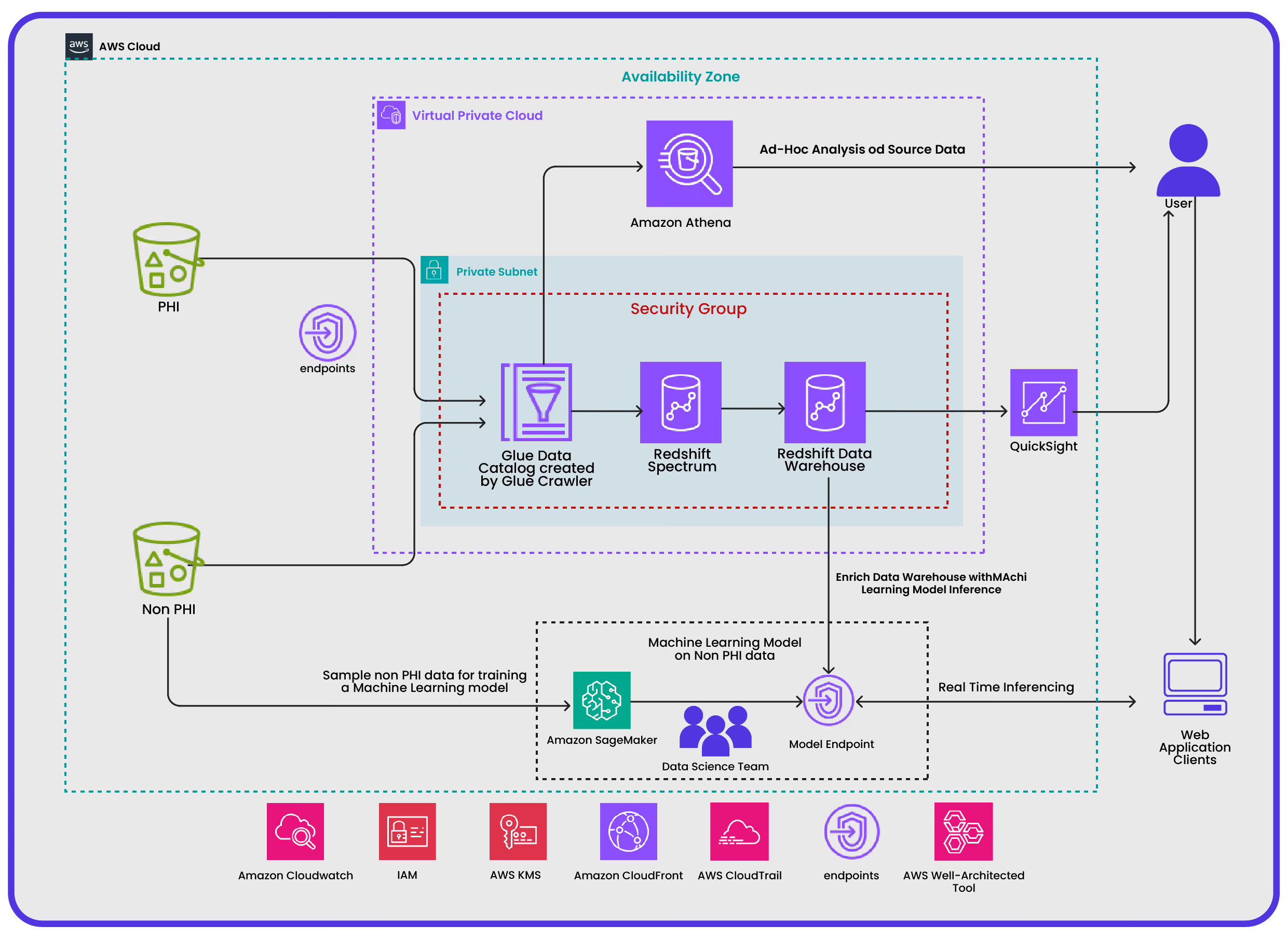
The customer’s data pipeline followed a collect, store, process/analyze, and consume model, leveraging multiple AWS services. Their data lake was created in an Amazon S3 bucket, and the data lake's stored data can be queried using dbt, utilizing AWS Glue Data Catalog Databases and Crawlers.We recommended Amazon Redshift and Redshift Spectrum to build their data warehouse. After mapping the data with Redshift Spectrum, Amazon Redshift processes the data to Redshift tables. Data is then visualized and consumed by users through Amazon QuickSight.
AWS Services Adopted for this Solution
- Amazon S3, for data lakes
- AWS Glue, as a data datalog
- Amazon Redshift, as a data warehouse
- Amazon Quicksight, for data visualization
Data Processing Solution for Healthcare Organization
Amazon Redshift's scalability and flexibility make it easy to manage expanding data volumes effortlessly. With Redshift, customers can reduce their total cost of ownership (TCO) associated with database environments. Redshift also provides a centralized and secure data storage solution, that also automatically patches and backs up the data warehouse, storing backups for a user-defined retention period. This replication and continuous backups enhance availability and improve data durability, and can automatically recover from component and node failures.
Amazon Redshift’s parallel processing and compression capabilities accelerate command execution, enabling it to operate on billions of rows simultaneously. Redshift Spectrum integrates seamlessly with other AWS services (such as Glue), making it easy to build end-to-end data pipelines. This ensures that data is always up-to-date, accurate, and secure.
“Before moving to Amazon Redshift, our engineering team was spending too much time managing our on-prem data warehouse. Now, we are saving so much time on data management, and our data analysis has improved significantly.”
- CIO, Healthcare Insurance Provider
Data Processing Results
With Amazon Redshift and additional AWS services, the customer gained a centralized and secure data storage solution, and a streamlined data analysis process. The scalability and flexibility of Redshift empowered the customer to handle expanding data volumes seamlessly.
Get started with Healthcare Data Processing
Take the first steps to improve your healthcare data processing to see increases in data security, analysis, and scalability. Contact Cloudtech today.
.avif)
Mizaru- Online Platform for Specially Abled People To Get Support Services
Project Summary
Creating a Marketing website using ReactJS and AWS for the client to showcase what they do and how they do.
Feature enhancement in an existing web application where people with disabilities can request a communication facilitator or a support service provider and providers can accept a request and receive payment.
Problem Statement
The client divided the project into several MVPs.
As part of MVP-1, the client wanted to create a marketing website that is fast, secure, and allows people to understand what Mizaru is and how it can benefit them. They wanted a website that performs operations faster, is secure from the bots, and is cheaper to maintain.
MVP-2 involved enhancing the client’s existing web application, which was previously very basic. They wanted to implement features like admin dashboard management, QR code-based check-in and check-out of providers to provide service, etc.
In MVP-3 they wanted us to create a mobile application to perform the same functionality.
Our Solutions
1) We created a marketing website for the users using ReactJS. This provides us with a faster way to create and serve the application.
2) For deployment and maintenance, we used AWS. It reduced our cost and maintenance efforts.
3) For enhanced security from bots, we’ve implemented google ReCaptcha v3.
4) Once the user has a clear understanding, they are moved to a web app or a mobile App.
5) Through the web app customers (People with disability) can create a request based on their requirements (e.g. Need a communication facilitator or support service provider). Our application provides a way for people with disabilities to connect with service providers. This request will be visible to multiple service providers in the network and they can choose to accept or reject the request.
6) We integrated a payment gateway for processing the payment. Also, both customers and providers get notified of the multiple events. We created a dashboard for Admins to see the track of various requests and generate reports as per their needs.
Technologies
Express JS, React JS, Redux, AWS, GIT, Hubspot, Google Recaptcha v3
Success Metrics
- Created and delivered marketing website within the given timeframe.
- Created report generation feature for admin.
- Implementation of QR code based check-in and check-out of provider.
- Email reminders for customer and providers before service.
Mid-Market Financial Services Organization Finds Success with Event-Driven Architecture
About
This financial services organization provides financial planning, advice, and educational resources that investors need in a timely manner - including retirement planning, wealth preservation, brokerage services, and more. The organization services customers worldwide to help them realize their financial goals.
Business Challenge
The data ingestion process of a well-known financial services organization was not designed to scale to handle peak and projected future volume levels. Failures in that process could directly impact their ability to provide accurate and timely analysis, reporting, and investment advice.
Were that to happen, the ensuing reduction in assets under management and future opportunity loss would easily total tens of millions of dollars. Additionally, the data came from multiple sources in multiple formats and the whole system was governed by FINRA compliance regulations, including data encryption.
Technical Challenge
The organization needed an event-driven data processing solution that securely ingests, prepares, analyzes, and scales during peak and projected volume levels. This solution needed to handle data from multiple data sources in multiple formats, be cost-effective, and meet their FINRA compliance regulations. This solution would also allow the organization to have access to timely analysis and reporting with a comprehensive visualization of the data.
AWS Services Adopted for this Solution
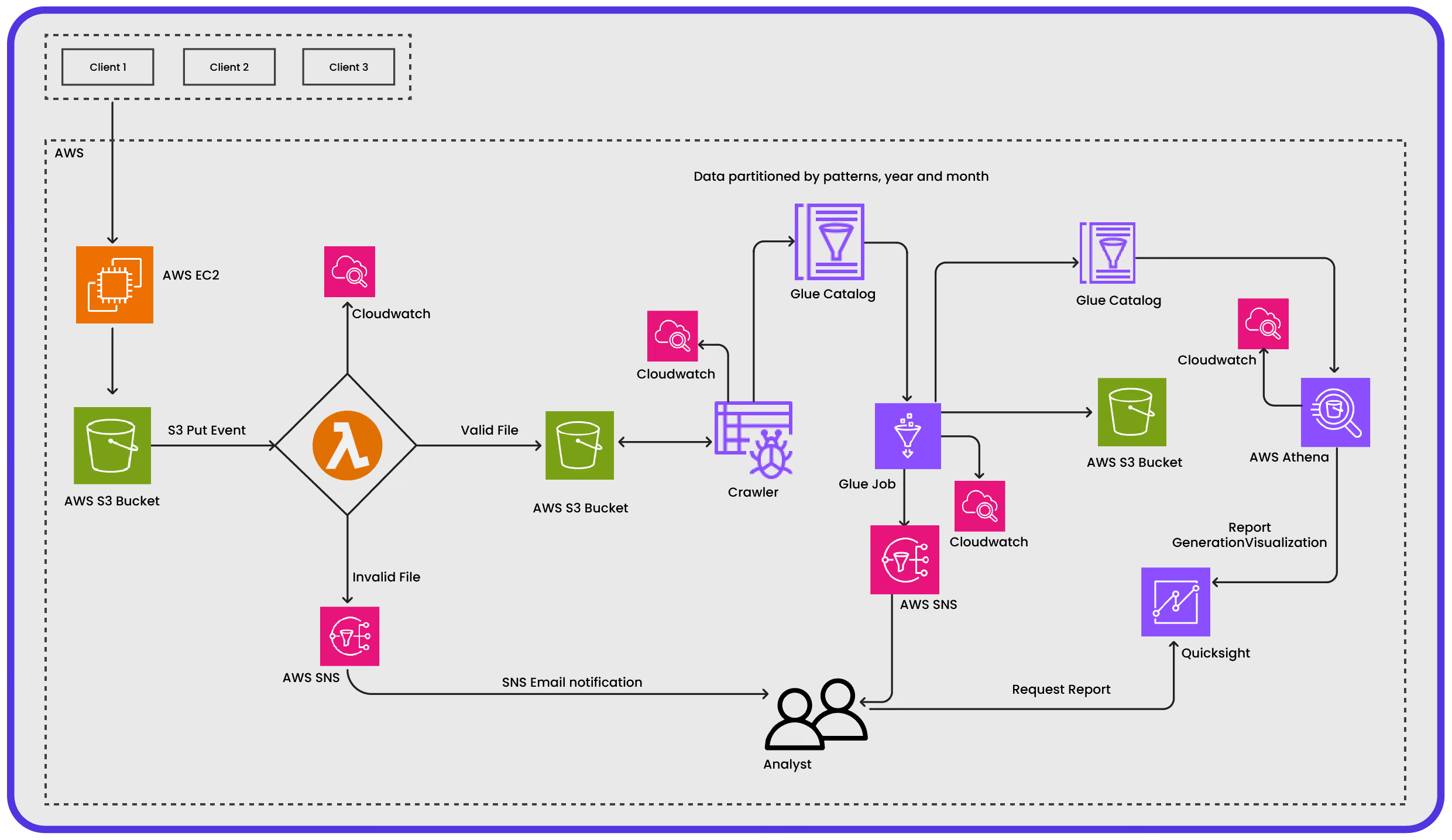
- Amazon EventBridge, for data requests
- AWS Lambda, for file validation
- AWS Glue, for ETL
- Amazon Athena, for queries
- Amazon QuickSight, for data visualization
- Amazon CloudWatch and Amazon SNS for monitoring and alerts
Event-Driven Architecture Solution for Financial Services Firm
Cloudtech implemented an event-driven solution anchored by Amazon EventBridge, AWS Lambda, and AWS Glue. During non-working hours, Amazon EventBridge triggers Lambda to request new data and store it in Amazon S3. AWS Lambda also performs file validation before moving on to a AWS Glue Crawler and then AWS Glue Job for ETL to an AWS Glue Catalog, where the data is queried using Amazon Athena and visualized using Amazon QuickSight. Monitoring and alerting are handled throughout the process flow using Amazon CloudWatch and Amazon SNS. The result not only enhances scalability and accuracy, but also enables cost savings.
“Cloudtech's event-driven architecture solution is the backbone of our timely and accurate investment advice that our clients rely on.”
- VP of Engineering, Financial Services
Event-Driven Architecture Results
Cloudtech provided the organization with an event-driven data processing solution which was secure, scalable, and handled multiple data sources and data formats. In addition, the solution provided timely analysis, reporting and a comprehensive view which allowed the organization to provide accurate investment advice to their clients. In turn, this solution helped the organization avoid the potential future opportunity losses which could have cost them tens of millions of dollars.
Increase Your Data Security
Learn how you can realize the benefits of an event-driven architecture for your financial services data, to improve security, analysis, and customer experience. Contact Cloudtech today.